Consumer Behavior
Utility refers to the level of satisfaction or benefit a consumer gains from consuming a particular good or service at a given time.
Utility should not be confused with externality. While utility relates to the satisfaction a person gets from his or her own consumption, an externality refers to the effect (positive or negative) that a person experiences as a result of another person’s consumption.
- When a person gains satisfaction from a commodity he or she directly consumes, it is called utility.
- When a person experiences dissatisfaction from a commodity he or she directly consumes, it is known as disutility.
- When a person gains satisfaction indirectly from another person’s consumption, it is referred to as a positive externality.
- When a person suffers dissatisfaction indirectly from another person’s consumption, it is called a negative externality.
Forms of Utility
1. Place Utility
Place utility refers to the satisfaction a consumer derives from the location where a good or service is made available or consumed. The place of purchase can influence a consumer’s perception of value or quality.
For example, a person may prefer to have a haircut at Victoria Island for ₦10,000 instead of getting the same haircut at Ikorodu for ₦500 because they believe the environment reflects higher quality.
2. Possession Utility
Possession utility is the satisfaction gained from owning a product. Ownership gives the consumer control over the product and the ability to use it to satisfy specific needs or purposes.
3. Time Utility
Time utility refers to the satisfaction a person obtains from consuming a good at a particular time. The value of a product may depend on when it is used.
For example, the enjoyment of freshly prepared soup is usually greater than that of soup that has been stored for three days.
4. Form Utility
Form utility is the satisfaction a consumer derives from a product due to its structure, design, or transformation. The way a product is shaped or processed can increase its usefulness and appeal.
Concepts in Utility
1. Total Utility (TU)
Total Utility refers to the overall satisfaction a consumer gains from consuming a certain quantity of a commodity. It is obtained by adding all the individual satisfactions derived from each unit consumed.
Formula: TU = AU × Q
2. Marginal Utility (MU)
Marginal Utility is the additional satisfaction a consumer obtains from consuming one more unit of a commodity. It is calculated by subtracting the previous total utility from the current total utility.
Formula: MU = Change in TU (TUn − TUn-1)
3. Average Utility (AU)
Average Utility is the satisfaction a consumer derives per unit of a commodity consumed. It is determined by dividing total utility by the quantity of the commodity consumed.
Formula: AU = TU / Q
Total Utility and the Law of Diminishing Marginal Utility
As a consumer continues to consume additional units of a commodity, Total Utility (TU) increases at first. However, it increases at a decreasing rate until it reaches a maximum point where Marginal Utility (MU) becomes zero. Beyond this point, Total Utility begins to decline.
The Law of Diminishing Marginal Utility
This law states that as more units of a particular commodity are consumed within a given period (while other factors remain constant), total utility increases at a diminishing rate. In other words, each additional unit consumed provides less satisfaction than the previous one.
The Law of Diminishing Marginal Utility explains why the demand curve slopes downward.
Limitations of the Law of Diminishing Marginal Utility
- All units of the commodity must be homogeneous (identical).
- Prices must remain constant.
- The commodity must be divisible.
- The consumer must act rationally.
Approaches to Consumer Behaviour
There are three main approaches to the theory of consumer behaviour:
1. Cardinal Approach
The cardinal approach was developed by neo-classical economists, notably William Stanley Jevons and Alfred Marshall. This theory assumes that utility can be measured in numerical terms called utils. Utility may also be expressed in monetary units such as Naira and Kobo.
Utility Maximization under the Cardinal Approach
Utility maximization involves two conditions: the necessary condition (first-order condition) and the sufficient condition (second-order condition).
Necessary Condition
For one commodity, utility is maximized when:
MUx = Px
For two commodities, utility is maximized when:
MUx / Px = MUy / Py
Sufficient Condition (Income Constraint)
The income constraint must also be considered:
PxQx + PyQy = M
Where M represents consumer income, Px and Py are the prices of commodities X and Y, and Qx and Qy represent their respective quantities.
2. Ordinal Approach
The ordinal approach assumes that utility cannot be measured numerically. Instead, consumers can rank their preferences in order of importance.
3. Revealed Preference Approach
The revealed preference approach determines consumer preferences based on actual purchasing behaviour rather than assumed satisfaction levels.
Consumer Surplus
Consumer surplus is the difference between the amount a consumer is willing and able to pay for a good and the amount actually paid.
Indifference Curve
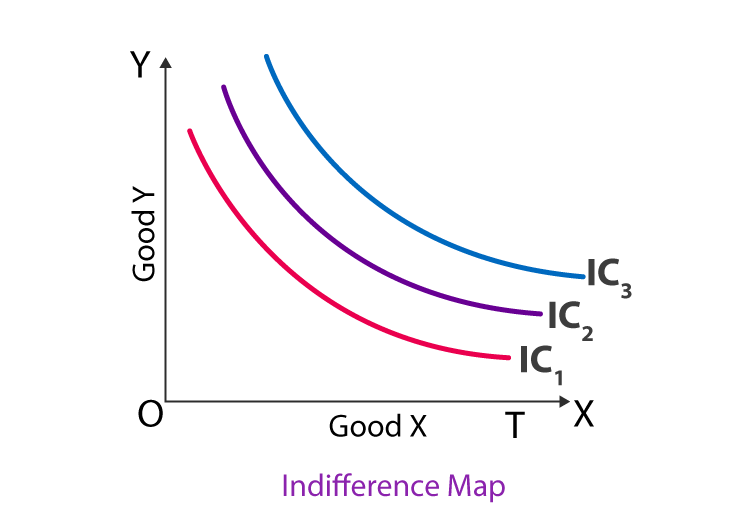
An indifference curve represents the set of combinations of two goods that provide the consumer with the same level of satisfaction (equal utility).
When several indifference curves are drawn on a graph, they form an indifference map, which is a family of indifference curves.
 Credit: Byjus.com
Characteristics of an Indifference Curve
- It is downward sloping (has a negative slope).
- It is convex to the origin.
- The farther the curve is from the origin, the higher the level of satisfaction.
- Indifference curves cannot intersect, as this would violate the law of transitivity.
The Budget Line
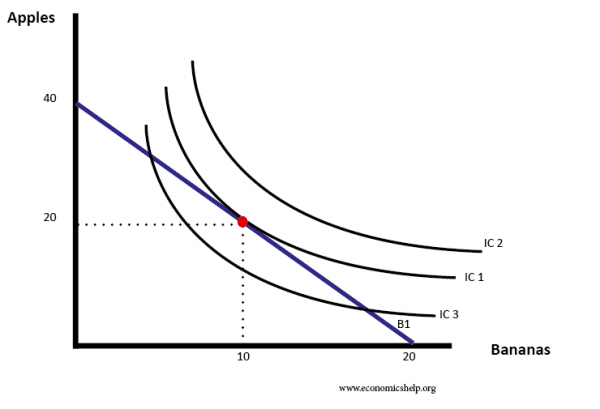
A budget line, also known as an income line, is a graphical representation of a consumer’s income. It shows all the possible combinations of two goods that a consumer can purchase given a fixed level of income and given prices.
 Credit: economicshelp/
Utility Maximization under the Ordinal Theory
Under the ordinal approach, utility is maximized at the point where the indifference curve is tangent to the budget line. At this point, the slope of the budget line is equal to the slope of the indifference curve.
Slope of the Budget Line
The slope of the budget line is the ratio of the prices of the two commodities.
Slope of Budget Line = Px / Py
Slope of the Indifference Curve
The slope of the indifference curve is the ratio of the marginal utilities of the two commodities.
Slope of Indifference Curve = MUx / MUy
Equilibrium Condition
At the point of utility maximization:
Px / Py = MUx / MUy
Rearranging the equation gives:
MUx / Px = MUy / Py
Utility Maximization under the Cardinal Approach
Under the cardinal theory, utility is maximized when two important conditions are satisfied: the First-Order Condition (FOC) and the Second-Order Condition (SOC).
First-Order Condition (FOC)
The first-order condition, also known as the necessary condition, states that if this condition is not satisfied, utility maximization has not been achieved.
When Two Commodities Are Consumed:
MUx / Px = MUy / Py
When Only One Commodity Is Consumed:
MUx = Px
Second-Order Condition (SOC)
The second-order condition, also known as the sufficient condition, ensures that the consumer can afford the chosen level of consumption. It incorporates the income constraint.
When Two Commodities Are Consumed:
PxQx + PyQy = I
When Only One Commodity Is Consumed:
PxQx = I
Where:
- Px = Price of commodity X
- Py = Price of commodity Y
- Qx = Quantity of commodity X
- Qy = Quantity of commodity Y
- MUx = Marginal Utility of X
- MUy = Marginal Utility of Y
- I = Consumer’s income